
MERCHANDISING TO BOOST YOUR SALES

In a local shop, the way products are displayed can make all the difference. A good product isn’t always enough: it also needs to be visible, easy to understand and accessible to the customer.
This is precisely the role of merchandising: a set of techniques that organises the sales area to guide the customer and encourage purchases. For delicatessens and independent shops, these principles can become a real driver of sales performance. An expert in retail display design, Hélène Genter has been helping shopkeepers organise their shops for over fifteen years. Her approach is based on a simple idea: a well-designed shop must tell a story, facilitate the customer journey and showcase the products.
What is merchandising?
Merchandising involves presenting the right products, in the right place and at the right time, to facilitate the purchasing decision. In practical terms, it encompasses several aspects:
- Product presentation
- The organisation of the sales area
- The customer journey within the shop
- Highlighting certain products
For Hélène Genter, it is above all a matter of putting oneself in the customer’s shoes and observing how they move through the shop. Understanding this journey allows the layout to be adapted and products to be highlighted at the right moment.
Merchandising is therefore not just about aesthetics: it is a strategic tool for making the shopping experience more intuitive and enjoyable.
A key lever for independent retailers
In an independent shop, every square metre counts. The shop layout must therefore be designed to maximise product visibility and facilitate customer flow.
Effective merchandising helps to:
- Improve the shop’s sales performance
- Boost sales
- Guide the customer through their shopping journey
- Make the in-store experience more seamless
When the layout is well-designed, customers naturally discover several products during their visit, which can encourage impulse purchases.
Organising your shop into strategic zones
A retail outlet can be structured around several zones that correspond to the different stages of the customer journey.
The transition zone, located at the entrance, is the first point of contact with the shop. It is the ideal place to highlight new arrivals, promotions or the latest news.
The hot zone, often situated to the right of the entrance, is an area where customers naturally pass through. Impulse-buy products or particularly attractive items can be placed here.
The cold zone, generally at the back of the shop, is reserved for products that customers are willing to make an effort to find.
Finally, the checkout area is a strategic space for additional sales. This layout optimises the customer journey and gives each area a specific commercial function.
The entrance display: a key area for attracting attention
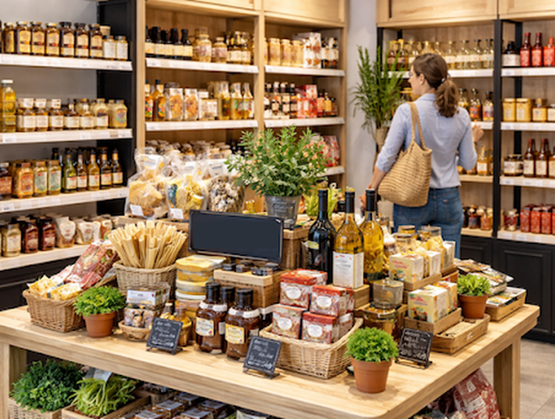
This space can be used to:
- Showcase new arrivals.
- Showcasing themed selections.
- Highlighting seasonal products.
To capture attention, it is advisable to focus on the display: vary the heights, create a visual composition or combine several complementary products.
Offering different price ranges can also be effective so that every customer can find a product suited to their budget.
Positioning products correctly on the shelves
A product’s position on a shelf greatly influences its visibility.
A few simple principles can help optimise shelf organisation:
- At the top: premium products.
- At eye level: attractive or visually striking products.
- Within easy reach: best-selling products.
-
At the bottom: bulky or sought-after products.
This hierarchy naturally guides the customer’s gaze and influences their choices.
Merchandising for profitability
Merchandising is not merely a visual tool. It is also a genuine tool for commercial management.
To measure the effectiveness of a shelf or sales area, it is useful to monitor several indicators:
- Turnover.
- Quantities sold.
- Average basket value.
- Conversion rate.
This data helps identify which products perform best and check whether they are also the most profitable. In some cases, a highly visible product may generate a lot of sales but a lower margin. Regular analysis of these indicators therefore allows merchandising to be adjusted to improve the shop’s overall performance.
How to boost underperforming areas
Sometimes an area of the shop is less frequented or generates few sales. Several simple actions can help revitalise these areas:
- Improve the lighting to catch the eye.
- Use colours to create a focal point.
- Reposition certain strategic products.
- Change the layout of the shelf.
Sometimes, simply moving a product can be enough to transform the dynamics of a space.
5 merchandising rules to apply immediately
To quickly improve a shop’s performance, a few simple principles can make all the difference.
1. Highlight new arrivals right at the entrance
The entrance area must grab attention and make customers want to explore the shop.
2. Create visual displays
Offer themed selections or product combinations to tell a story.
3. Organise shelves according to visibility
The products you want to sell should be placed at eye level or within easy reach.
4. Regularly analyse performance
Track turnover, sales volumes and average basket size to adjust your merchandising.
5. Give products space
An open, airy display makes the shelf easier to browse and encourages customers to pick up products.
Download the “Good Taste Guaranteed” magazine
Download the magazine to discover the latest trends, product innovations and best practices in the sector.
Are you a professional in the quality food sector?
Are you a fine food owner, distributor or retailer looking to offer high-quality gourmet products to your customers?
Come and discover the latest products and meet the producers at the Gourmet Selection trade fair, on 7 and 8 June 2026 at Paris Expo Porte de Versailles – Hall 7.2.