
WHEN FINE FOOD BECOMES PART OF THE HOTEL EXPERIENCE

A symbol of quality and expertise, fine food is increasingly appealing to players in the hospitality sector. In an industry where the culinary experience is becoming a key differentiator, fine food products naturally find their place, from room service to courtesy trays and bar menus.
Reinventing hospitality through taste
With more than 16,000 establishments recorded by INSEE as at 1 January 2025, France’s hotel sector offers an unrivalled wealth of accommodation options. After all, it is no coincidence that France is the world’s leading tourist destination. But there is a flip side to the coin: venues that end up looking alike, an experience that is all too often standardised, and services lacking in individuality.
The result is a uniformity that leaves 45% of guests feeling jaded, according to surveys of travellers conducted by Coach Omnium, a firm specialising in hospitality customer research. By trying too hard to please everyone, you end up failing to make an impression on anyone. Yet hoteliers have an ace up their sleeve: their natural connection with gastronomy. From breakfast to room service, from the courtesy tray to the restaurant table, every moment of dining can become an opportunity to delight and a way to embody the venue’s promise, whilst driving customer loyalty and generating additional sales.
Co-creating a menu for a hotel group
In the midst of the pandemic, whilst hotel restaurants were forced to close, the Atypio group (operating hotels under the Mercure, Novotel, Hilton and Best Western brands, amongst others) sought a solution to maintain a high-quality catering service. That’s where Aix&Terra came in. “They came to see us because their guests could no longer dine in the restaurant. We already had an existing offering that could easily be adapted for room service,” recalls Richard Alibert, founder of the brand and the eponymous Manufacture.
This health-related constraint gave rise to a unique catering concept, ‘À l’épicerie’, a menu inspired by the Manufacture’s historic Table-Épicerie, co-created by Aix&Terra and the group’s chefs using the company’s own produce. Today, the concept is rolled out across 25 establishments in France. In these hotels, the experience extends into the lobby with a delicatessen, where guests can take home the products they’ve discovered at the table. “This represents a strong partnership for Aix&Terra,” concludes Richard Alibert.
Enhancing the experience of unique accommodation
Tree houses, yurts and caravans in the heart of nature. Unique accommodation appeals to guests seeking an escape and authenticity. Behind the promise of a chance to switch off lies a challenge: providing a comfortable experience when there are no dining options nearby. Far removed from the standards of traditional hotels, where one simply needs to pop down to the restaurant or pick up the phone to get something to eat, these establishments have had to find a solution.
Domaine Terra, a gourmet preserve producer based in Aquitaine, quickly caught the attention of two regional tourism organisations, ÉcÔtelia (Gironde) and Les Landines (Landes), which have incorporated the brand’s vegetable terrines into their packed lunch options. Convenient and locally sourced, these dishes fit naturally with the eco-friendly ethos of these establishments. They add a touch of conviviality and indulgence to stays where every detail counts, thus becoming true ambassadors for the local region.
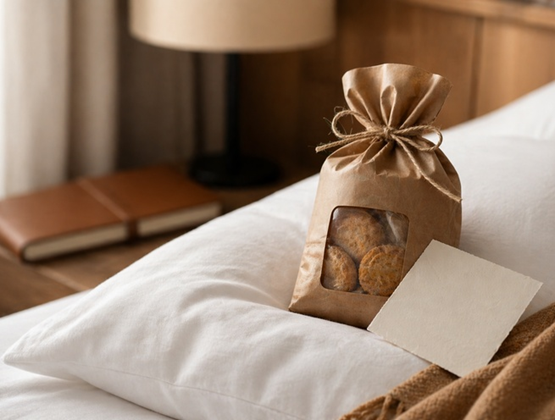
Recently, the brand devised an exclusive format for the neighbouring five-star hotel, Le Moulin du Roc: a small packet of biscuits, personalised with the guest’s name and placed in the room for premium guests. A delightful touch that perfectly illustrates the trend for thoughtful gifts in the high-end hospitality sector. This initiative, still in its early stages, holds great promise for enhancing the brand’s image and raising awareness of its products. “The luxury hospitality sector is an excellent communication channel. Guests who discover our products on a courtesy tray can then recognise them in shops or delicatessens,” emphasises Sylvain Boucher. “It doesn’t have a major impact on our turnover, but it’s a wonderful showcase for our expertise.”
Through these initiatives, a conviction is taking shape. Quality food is no longer confined to specialist shelves. It is becoming a means of differentiation in the hospitality sector, capable of extending the customer experience well beyond their stay. Whether it involves co-creating a menu, rethinking the packed lunch or devising a personalised gesture, it opens up new avenues for connecting gastronomy, the local area and emotion.
The hotel bar: a reflection of a venue’s identity
Whilst the minibar seems to be becoming an endangered species (now only mandatory for 5-star hotels according to the Atout France classification criteria), the hotel bar is becoming a destination in its own right.
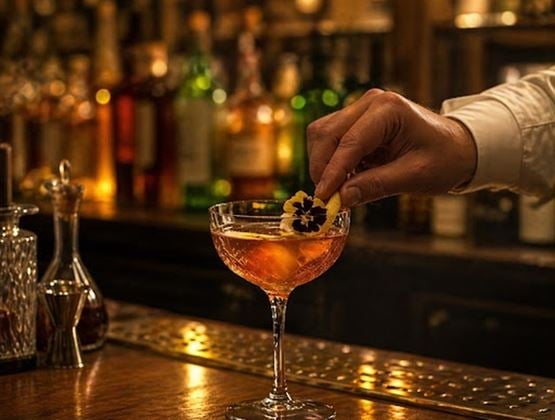
Today, a hotel is discovered as much through its rooms as through its drinks. The drinks menu naturally becomes a way of expressing a venue’s identity – blending refinement and eclecticism – to appeal to a multicultural clientele.
An essential feature, the ‘wines and spirits’ selection must combine internationally renowned labels with more local specialities, showcasing the surrounding region. When it comes to ‘cocktails’, mixologists are pushing the boundaries of creativity to offer a tasting experience that lives up to the element of surprise expected by guests. Non-alcoholic options are treated with the same high standards.
That leaves ‘hot drinks’, which are still largely confined to the classics. Speciality coffees, plant-based milks, matcha, cold brew and caffeine-free alternatives are all trends from which hotels could draw inspiration to satisfy a clientele now accustomed to these new offerings popularised by coffee shops.
These links between high-quality food retailers and the hospitality sector are among the trends regularly observed at Gourmet Sélection, which brings together artisan producers and influencers from the CHR sector (cafés, hotels, restaurants) to discuss the products that make all the difference to the customer experience.