
120 YEARS AGO, GROCERS ALREADY HAD THEIR OWN RULES

A sales catalogue is not a document of prestige. It is a working tool, printed to sell, which details what the shop had in stock, at what price, under what conditions and with what selling points. Reading it provides insight into something that history books rarely capture: the way in which a grocer put together his range and spoke to his customers.
A grocers’ and druggists’ catalogue dating from 1904–1905 takes us back to the day-to-day life of a shop from another century. Top-quality products, coffees, chocolates, tinned goods, confectionery, wines, regional specialities… Behind the prices in francs and the period typefaces, we find a trade surprisingly similar to that of today’s grocers.
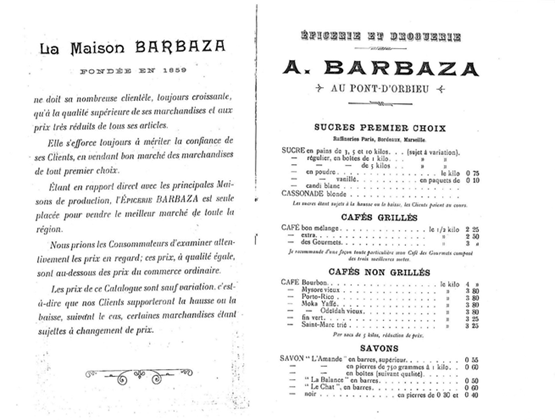
“Elegance & Good Value”: the slogan takes pride of place in the centre of the cover.
Quality, trust, choice of suppliers, price control: ultimately, there is nothing particularly new in these fundamentals of the specialist retail trade.
Nor does the catalogue shy away from certain constraints of the trade: several prices are listed ‘subject to change’, with customers having to absorb both price rises and falls, depending on the product. Price volatility is by no means a recent concern.
An extraordinarily diverse grocery range
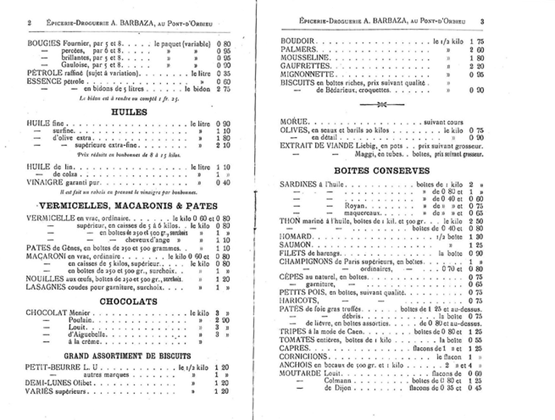
The document begins with a few essentials: top-quality sugars from the refineries of Paris, Bordeaux or Marseille, roasted and green coffees, and soaps, before revealing a far wider range than one might imagine. Oils, vinegar, a wide selection of pasta, as well as several brands of chocolate: Menier, Poulain, Louit, Aiguebelle. Biscuits also feature prominently.
The tinned food section gives a good idea of the breadth of the range: sardines in oil, marinated tuna, lobster, salmon, herring fillets, button mushrooms, porcini mushrooms, peas, beans, tomatoes, capers, gherkins and anchovies. And the delicatessen section is never far away, with truffled foie gras pâtés, hare pâtés and a variety of mustards.
Roquefort, Agen prunes and regional specialities
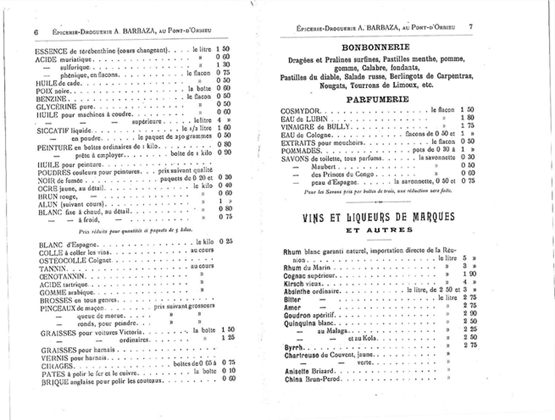
Products from further afield
Delivery was already a thing
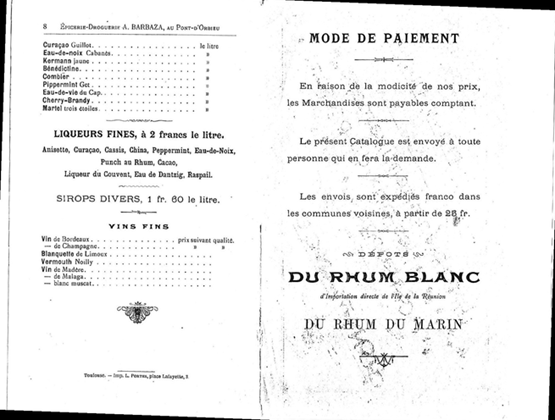
One final surprise at the end of the catalogue: the document was sent to anyone who requested it, and goods could be delivered free of charge to neighbouring towns provided the order was above a certain value. A mail-order catalogue, ordering, local delivery – long before online shopping, the grocer was already seeking to reach beyond the walls of his shop.
What hasn’t really changed
Shops have changed, as have the tools of the trade, and standards have been significantly tightened. Yet, reading this catalogue from the early 20th century, one realises that the very essence of the fine grocer’s trade has stood the test of time rather well.
These documents were, however, never intended to last. Printed in large runs, distributed free of charge and replaced every season, most of them have disappeared. Those that remain have become a key source for the history of commerce, to the extent that heritage institutions are collecting and digitising them: the Bibliothèque Forney has, for example, made hundreds of department store catalogues published between the 1860s and 1940s available online via Gallica, where one can trace the evolution of the items sold as well as that of the sales pitches.
This record of the trade forms part of what the Fédération des Épiciers de France passes on to independent grocers, alongside legal assistance, regulatory documentation and professional training. Knowing the trade’s origins also helps to understand what, in the world of quality grocery, is merely a passing fad and what constitutes the bedrock of the trade.
Gourmet Selection brings this foundation back into focus every year. On 13 and 14 June 2027, at Paris Expo Porte de Versailles, retailers, producers and specialists will come together for two days to source, compare and build their range for the following season.