
Seniors: why this customer group is so important to fine food shops

A growing share of the population
The term ‘senior’ does not correspond to a specific age. The study by Ipsos bva cited below focuses on those aged 55 and over, whilst that by FranceAgriMer focuses on households aged 65 and over. The relevant age group is therefore specified for each figure.
According to the INSEE’s 2025 Demographic Report, France had a population of 69.1 million as at 1 January 2026, of whom 22 per cent were aged 65 or over – almost as many as those under 20. In 2025, life expectancy at birth reached 85.9 years for women and 80.3 years for men. This trend is set to continue. According to Ipsos bva, nearly one in four French people will be over 65 by 2030.
Older people who feel younger than their age
The Génération Encore study, carried out by Ipsos bva for BIOVANCIA and published on 16 June 2026, surveyed French people aged 55 and over on the topic of ageing well. The quantitative survey was conducted on 9 and 10 April 2026 amongst 1,000 people, and was supplemented by a qualitative component. The average actual age of the respondents is 67, whilst their perceived age is 53 – a difference of 14 years. 78 per cent feel physically fit, 71 per cent feel mentally well and 85 per cent describe themselves as independent. Nearly one in two (48 per cent) even say they are experiencing the best years of their lives.
These older people also claim a great deal of freedom to be themselves, according to the Ipsos bva study. 92 per cent believe that the greatest privilege of old age is being able to be fully oneself. 77 per cent find the phrase ‘you’re too old for that’ unbearable, and 61 per cent are bothered by the word ‘old’. Finally, 80 per cent would like to see people over 65 featured more prominently in advertising and the media. For retailers, these figures suggest that this customer group should be approached as active and curious connoisseurs, with age taking a back seat.
‘Neo-seniors’: an engaged and curious customer base
Amongst the elderly, those aged 55–75 – often referred to as ‘neo-seniors’ – form a distinct group. As at 1 January 2026, France had 16.4 million people aged between 55 and 74, representing nearly one in four residents, according to provisional estimates by INSEE by age group.
This is also the age at which people typically retire. According to the DREES report *Retirees and Pensions* (2025 edition), the current average retirement age stands at 62 years and 9 months. DREES also indicates that the median standard of living for pensioners is equivalent to that of the population as a whole (2022 data).
Their interest in high-quality food is growing. The 2026 Barometer of Organic Products in France, published by the Agence BIO and L’ObSoCo, shows that in 2025, 30 per cent of 55–64-year-olds and 33 per cent of 65–75-year-olds consume organic products at least once a week, compared with 27 per cent and 30 per cent respectively a year earlier.
€40 billion spent on food
To gauge the proportion of seniors’ spending in the shopping basket, FranceAgriMer analysed the purchases of households aged 65 and over between 2007 and 2024, using data from Worldpanel by Numerator. In 2024, these households spent 40 billion euros on food, representing 30 per cent of the nearly 134 billion euros spent by all French households. Their shopping basket contains more fresh produce than that of the average population. Meat (20 per cent) and dairy products (17 per cent) account for the largest share of their budget.
Older people are also very prominent in the supermarket sector. According to NielsenIQ, in 2024, those aged 65 and over accounted for 29 per cent of shoppers buying fast-moving consumer goods and self-service fresh produce in large food retailers, spending 35 billion euros a year.
Their households are smaller. Another analysis by NielsenIQ, published in April 2025, indicates that 95% of households of those aged 65 and over consist of one or two people. For fine food, this data points to the need for tailored formats: small containers, individual portions, and sale by the piece or by weight.
Quality, freshness and organic
According to FranceAgriMer, the food choices of those aged 65 and over are increasingly guided by health, wellbeing and product quality. This is reflected in their spending on organic produce, which accounts for 5 per cent of their food budget, compared with an average of 4 per cent (2022–2024). A person aged 65 and over thus buys 6.2 kg of organic fruit and vegetables, compared with 3.9 kg for the average French person. These customers are also particularly attentive to freshness, local origin and proximity to retailers. FranceAgriMer also highlights their purchasing power, which is high on average.
For grocers and department managers alike, these expectations pave the way for a clearly defined product range. AOP, IGP and Label Rouge certifications, clearly indicated provenance and the producer’s story are all selling points to be highlighted on the shelves and when advising customers.
From specialist shops to supermarket shelves
Older people appreciate local shopping channels. According to FranceAgriMer, those aged 65 and over shop at specialist outlets more frequently than average. At open-air markets, they alone account for more than half of all fruit and vegetable purchases. Among generalist retailers, they favour smaller shops.
Their habits are also changing. FranceAgriMer notes that their use of click-and-collect services is on the rise and suggests a possible shift in their fruit and vegetable purchases towards large retailers specialising in fresh produce, which have seen a 44% increase. Local shops, markets, supermarkets: this customer base is spread across several retail channels, and each can offer them a high-quality range tailored to their expectations.
Cooking at home: a skill to be valued
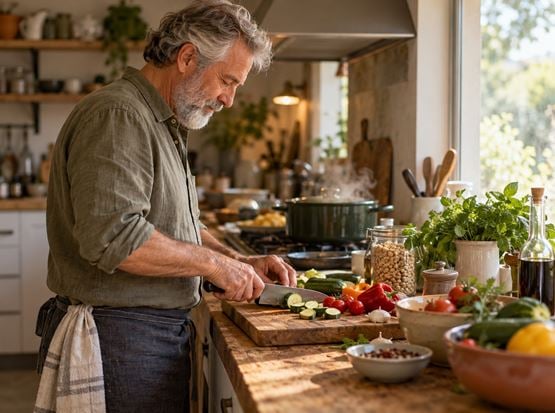
According to an analysis by Kantar on trends in French consumption, published in February 2025, 50 per cent of turnover from traditional fresh produce comes from customers aged over 60. Kantar puts forward three explanations. These customers have been familiar with these foods since childhood. They have more time on their hands and greater purchasing power. Finally, they possess well-established culinary skills and know how to prepare and cook these products.
However, some of their habits are similar to those of the rest of the population. In its study on food consumption amongst older people, FranceAgriMer highlights the purchase of ready meals and the decline in time spent in the kitchen. In 2024, people aged 65 and over bought an average of 11 kg of ready meals, which is 1 kg more than the average for the French population.
This dual expectation opens up a rich market for high-quality groceries. Oils, vinegars, spices, condiments, pulses and flours naturally find their place in the kitchens of customers who take the time to cook for themselves. A carefully curated catering range caters for those days when people cook less. Suggesting a recipe, recommending a pairing or combining a cheese platter with jams, dried fruit or oils builds on this expertise.
When the pleasure of eating comes through connection
The Crédoc sheds light on another, more intimate dimension. Its publication “When loneliness weighs on the pleasure of eating”, released in April 2026, shows that 43 per cent of independent over-65s living alone report a lack of appetite or desire to sit down to a meal, compared with 32% of those living with others. The desire to eat well is therefore also fuelled by sharing and relationships.
The food retail sector has a real role to play here. A tasting session, a meeting with a producer or personalised advice help to foster this connection, as does the simple act of recognising a customer and knowing their tastes. Opening a product to offer a sample to a regular customer – because you know what will please them – gives the customer the feeling of being welcomed and builds lasting loyalty.
Three ways to welcome them, both in-store and on the shelves
The first approach concerns the messaging. Rather than a range labelled ‘for the over-50s’, it is better to highlight the flavour, origin and quality of the products – criteria to which this customer base pays particular attention. Visuals and promotional activities featuring people of all generations also reflect their desire to be better represented.
The second strategy concerns product formats and the shopping experience. With one- or two-person households, small pack sizes, cut-to-order portions and taster packs allow customers to enjoy variety without waste. Clear labelling and easy-to-open packaging also make shopping easier, for this customer group as for all others.
The third key factor centres on customer relationships. Advice, explanations about the origin of products, recipe ideas and tasting sessions turn the shop into a meeting place as much as a place to shop. Feedback from these loyal customers is also a valuable source of ideas for developing the product range.
At Gourmet Selection, a range designed for all generations
Following on from Generation Z and the millennials, this profile of older consumers completes the picture of those shopping for quality groceries. The studies and trends at the trade fair track these shifts in consumer behaviour. The conferences at the Experts' Agora give a voice to the professionals who observe these trends on a daily basis. The Best Of competition helps identify products for a discerning clientele, whatever their age. For manufacturers, exhibiting at the trade show is an opportunity to present ranges to both independent grocers and mass-market buyers that appeal to this customer base: small-sized packs, locally sourced products with quality labels, ingredients for everyday cooking, deli specialities or gift sets.
Join us from Sunday 12 to Tuesday 14 September 2027 at Paris Expo Porte de Versailles for the next edition.